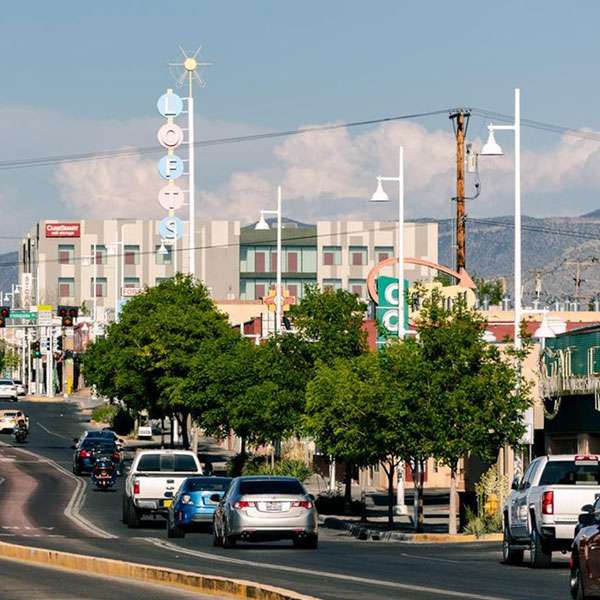
Asian District, OKC, OK
Route 66 centennial
monument destination
Oklahoma City’s Asian District is one of only two recognized Asian districts on Route 66
Welcome to Oklahoma City's Asian District
Xin cháo! (Hello!) You've arrived at one of the great surprises along the 2,448 miles of Route 66: one of the Mother Road's largest Asian American communities. Oklahoma City’s Asian District, centered on Northwest Classen Boulevard on Route 66’s original 1926 alignment, is home to dozens of family-owned restaurants, boba tea shops, grocery stores, and even a nail salon inside one of Oklahoma's most recognizable Route 66 landmarks, the Milk Bottle Building. Behind it all is a remarkable American story of refugees and immigrants who revitalized a struggling neighborhood.
It’s culturally rich, and even better if you come with an empty stomach.

Asian District Route 66 Centennial Monument, Oklahoma City
(opens in new tab)From Little Saigon to the Asian District
Originally referred to locally as Little Saigon, Oklahoma City's Asian District grew from the arrival of Vietnamese refugees after the Fall of Saigon in 1975. Many families first passed through Fort Chaffee in neighboring Arkansas before Catholic Charities helped them resettle in Oklahoma City. A couple of miles north of downtown, they found affordable homes and vacant storefronts and helped transform a struggling commercial corridor into today's thriving cultural destination.
"That area started to change because of that community opening restaurants, hair salons, and businesses," says Steve Le, the Executive Director of the Asian District Cultural Association, a son of Vietnamese immigrants. "That's kind of how that area of Route 66 started to become what is now known as the Asian District."
Today, Oklahoma is home to more than 137,000 Asian Americans and Pacific Islanders. Vietnamese Americans are the state's largest Asian ethnic group, with nearly 25,000 residents.
Visitors interested in learning more can watch “From Việt Nam to Oklahoma City,” an ongoing oral history project by the Vietnamese Boat People nonprofit organization. Through first-person interviews, refugees recount their journeys by boat and the lives they built in Oklahoma.
Link: https://www.vietnameseboatpeople.org/fc/oklahoma(opens in new tab)
YouTube: https://www.youtube.com/@vietnameseboatpeople(opens in new tab)
Milk Bottle & Military Park
Stretching from Northwest 23rd to Northwest 36th streets between Western and McKinley avenues, the district's best-known landmark is the whimsical 1948 Milk Bottle Building, featuring an oversized bottle atop a tiny triangular building. Over the years it’s been occupied by law offices, a banh mi (Vietnamese sandwich) shop, and (presently) a nail salon.

The Milk Bottle Building on Classen Boulevard (photo by Yaniv Adir / dreamstime.com)
Just north is Military Park, featuring Brothers in Arms, a 2017 statue of American and South Vietnamese soldiers standing, back-to-back, beside a pairing of U.S. and South Vietnamese flags.
Nearby is the park’s newest addition, We Have Arrived, a thirty-foot interactive sculpture of a traditional Vietnamese fishing boat. Designed by Oklahoma City artists Denise Duong and Gabriel Friedman, the piece honors refugees who escaped Vietnam by sea.

We Have Arrived, a life-size sculpture by artists Denise Duong and Gabriel Friedman in Military Park, depicts the arrival of Vietnamese-Americans in 1975
At the intersection of Northwest 23rd Street and Classen Boulevard at the district’s southern edge, the Gold Dome building (www.travelok.com(opens in new tab)) is reminiscent of a giant golden golf ball. Designed in 1958 by futurist architect Buckminster Fuller, the Gold Dome was once a bank before later serving as a cultural center, art gallery, and restaurant. Currently, the building has been purchased by developers to repurpose. It has been on the National Register of Historic Places since 2002.
Vietnamese Food
If you’re looking for a break from burgers and milkshakes on your Route 66 road trip, you're surrounded by some of Oklahoma City's defining food experiences—many of which are linked to some of the country’s most authentic Vietnamese cooking.
"It's a nice surprise for people as they travel Route 66,” says Steve Le. “You get to come into a thriving Asian district that you just wouldn't expect."

The Asian District has a number of restaurants offering pho
If Vietnamese food is new to you, begin with pho, the country’s celebrated beef noodle soup. First developed outside Hanoi in the early twentieth century, the soup base consists of a slow-simmered broth of beef bones and fragrant spices. It’s served with rice noodles, fresh herbs, and a choice of meat. Longtime favorite Pho Cuong (3016 N. Classen Blvd.) is located in a former Long John Silver’s (where Flaming Lips frontman Wayne Coyne worked for seventeen years). It also features another local specialty, bun bo Hue, which is a richer and spicier beef noodle soup that originated in the Central Vietnam city of Hue.

Pork Pho at Pho Cuong (photo by Megan Rossman / Oklahoma Tourism)
For quicker fare, try a bánh mì, a French-inspired Vietnamese sandwich with grilled pork or chicken packed into a crisp baguette with chili, cilantro, cucumber, and pickled vegetables. Quoc Bao Bakery (2501 N. Classen Blvd.) is a doughnut shop popular for its cheap bánh mì, while Lee’s Sandwiches (3300 N. Classen Blvd., leesandwiches.com(opens in new tab)) is another popular bánh mì spot and community hub. Visitors will be rewarded with a cup of ca phe sua da, the iconic Vietnamese iced coffee served with condensed milk.

The French-inspired Vietnamese sandwich, bahn mi, is on menus across the Asian District

Quoc Bao is a popular stop for bahn mi sandwiches and donuts in the Asian District
Meanwhile, the sprawling Super Cao Nguyen (2668 N. Military Ave.), the grand dame of Oklahoma City Asian markets, has been a stalwart of the area since the late 1970s. This comprehensive pan-Asian market provides meat and seafood, produce, and condiments for area restaurants and home chefs seeking ingredients from all over the world.

Super Cao Nguyen is a massive supermarket offering fresh produce, meat, fish, and ingredients from across Asia. Photo by Ricky Thai
Beyond Vietnamese Food
Although Vietnamese refugees established the neighborhood’s identity, today’s Asian District reflects a wider range of Asian cultures, including Chinese, Burmese, Thai, and Korean options in the area—and no shortage of boba tea shops.

The district’s annual Asian Night Market draws tens of thousands of people. Photo by Saxon Smith / Oklahoma Tourism
“You come into a thriving Asian district that you just wouldn’t expect, with a night market, different restaurants, and all these different things,” Le says. “It showcases the diversity that surprises people about Oklahoma.”
The list of options is long. Now in its fifth decade, Grand House (2701 N. Classen Blvd., grandhouseokc.com) serves Chinese dim sum on weekends. Nearby Chinatown Supermarket (1228 NW 27th St.) is a bustling grocery.

Grand House offers traditional Cantonese Dim Sum service on Saturdays, Sundays, and special holidays
In a repurposed house just off Classen, The Red Cup (3122 N. Classen Blvd., www.theredcupokc.com/(opens in new tab)) is a local institution for veggie breakfasts and locally roasted coffee. Keep an eye out for the resident chicken who often wanders the porch. Nearby, Cafe Kacao (3325 N. Classen Blvd., www.cafekacao.com(opens in new tab)) is a nationally recognized brunch spot, with Guatemalan-style meals that draw long lines on weekends.

The Red Cup, a bohemian fixture in the Asian district, offers vegan food and coffees (photo by Lori Duckworth / Oklahoma Tourism)
HQ Coffee (2600 N. Classen Blvd.), a newer arrival by Military Park, serves Korean-inspired matcha and black sesame lattes. For something more classically Route 66, Neptune Submarine Sandwiches (3301 N. Classen Blvd.), the site of the neighborhood’s Route 66 Centennial Monument, has been a local lunch favorite since the 1970s.
Festivals and Community
The district hosts several annual events, with the standout being October’s Asian Night Market Festival, a two-night gathering with dozens of food vendors, K-pop fashion/dance shows, and other cultural events. It started modestly with a few food trucks in 2018 and quickly expanded.

The annual Asian Night Market features hundreds of vendors and draws tens of thousands of visitors to the district
"The first year, they thought maybe 3,000 to 4,000 people would show up,” Le says. “But close to 15,000 people showed up the very first night."
Today there are close to a hundred vendors. Several blocks of Classen Boulevard are closed to traffic for the event, and it’s filled with cultural highlights.
“We have parents and kids walking around in their cultural garb,” Le says. “It’s really beautiful. People get to see how diverse the community is here in Oklahoma.”
See www.visitokc.com/events/annual-events/asian-night-market-festival(opens in new tab) for more details.
Converted from a modest house, the Blue Door (2805 N. McKinley Ave., www.bluedoorokc.com(opens in new tab)) has become one of Oklahoma City's best-loved listening rooms, hosting nationally touring folk, Americana, and singer-songwriter acts.
Beyond the usual chain hotels, Bradford House (1235 NW 38th St., www.bradfordhouseokc.com(opens in new tab)), a few blocks north of the Asian District, is a boutique hotel with a few dozen rooms occupying a 1912 Victorian home. The hotel’s colorful restaurant and bar is a destination for daily brunch, dinner, drinks, and photo ops.
For More Information
Asian District Cultural Association – (www.asiandistrictok.com(opens in new tab)).
Keep the Journey Going
- All Destinations
- California
- Illinois
- New Mexico
- Oklahoma